
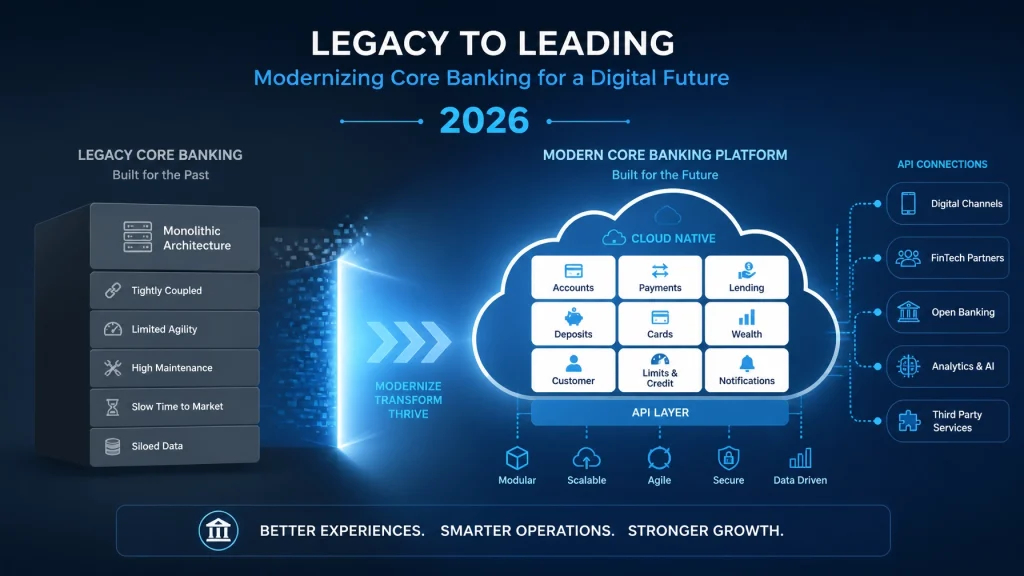
For many financial institutions, legacy technology presents a difficult balancing act.
On one side are growing expectations for faster digital services, easier integrations, real-time access and more flexible financial products. On the other is an established core banking system that may remain critical to daily operations but has become increasingly difficult to adapt.
Replacing that system can introduce considerable cost, complexity and operational risk. Keeping it unchanged, however, can make innovation increasingly difficult.
This tension is one of the central challenges behind legacy core banking modernization.
In 2026, the question for many institutions is no longer simply whether older technology should eventually be modernized. The more practical question is how to modernize without creating unnecessary disruption, cost or risk..
When a legacy core becomes a constraint
Legacy does not automatically mean obsolete.
Many established core banking systems continue to perform important functions reliably. They may contain years of institutional data, support critical workflows and be deeply integrated into daily operations.
The challenge appears when the institution’s requirements begin changing faster than the technology can accommodate them.
New digital channels may need to be introduced. External systems may require integration. Reporting requirements can evolve. Customers may expect faster and more accessible services.
Over time, institutions may find themselves adding increasingly complex integrations and customizations around an environment that was not originally designed for those requirements.
At that point, the question changes from:
“Does the existing system still work?”
to:
“Is the existing system preventing the institution from moving forward?”
That is an important distinction.
Why modernization has become more important
Financial institutions operate within an increasingly connected technology environment.
A banking platform may need to interact with payment infrastructure, identity services, reporting tools, customer-facing applications and other third-party systems.
At the same time, international payment standards such as ISO 20022 demonstrate the broader movement toward richer, more structured financial data and greater interoperability across financial infrastructure.
The practical implication is that banking technology increasingly needs to support change.
For institutions operating older systems, adapting to new requirements can become progressively more complicated when the underlying architecture was designed for a very different technology environment.
Modernization therefore isn’t simply about replacing old software with something newer.
It is about creating a technology foundation that can better accommodate future operational requirements, integrations and growth.
— Remy Swaab, CEO, Banking.Systems
“Modernizing a financial institution in 2026 is no longer about simply getting a fresh coat of paint on a mobile app. It is about restructuring core data flows to meet stringent global standards like ISO 20022 while maintaining absolute system stability. Institutions that treat compliance as a box-ticking exercise will fall behind; those that leverage it as a catalyst for architecture overhaul will lead the next decade.”
Modernization does not always require a complete replacement
One of the biggest misconceptions about legacy modernization is that an institution has only two choices:
Keep the existing core exactly as it is — or replace everything.
In practice, there are several possible approaches.
The appropriate strategy depends on the institution’s existing environment, operational requirements, available resources, risk tolerance and long-term objectives.
1. Full core replacement
A full replacement involves migrating from the existing core banking system to a new platform.
This can provide an opportunity to establish a new technology foundation, but it can also represent the broadest implementation scope.
Data migration, integrations, workflows, operational processes, testing and employee readiness all need to be considered.
For some institutions, full replacement may be appropriate. For others, the implementation risk and scope may make a more gradual strategy preferable.
2. Phased modernization
Rather than replacing the entire environment at once, an institution can modernize selected capabilities progressively.
Customer-facing functionality, reporting, payment-related services or other operational areas can potentially be addressed individually while existing technology continues supporting other functions.
This allows the modernization program to be divided into more manageable stages.
3. Parallel or coexistence strategies
Existing and newer technology can sometimes operate alongside each other during a transition.
This can allow institutions to introduce new functionality while retaining established systems for areas that are not yet ready to migrate.
The feasibility of this approach depends on the existing architecture, required integrations and project scope.
4. Hollowing out the core
Another strategy is often described as hollowing out the core.
Instead of immediately replacing an established core system, selected capabilities are gradually moved into a more flexible technology environment.
Over time, the legacy core can perform a narrower role while newer technology supports additional operational or customer-facing functionality around it.
For institutions concerned about the disruption of a single large migration event, this can provide a more gradual modernization path.
The role of configurable banking technology
A modernization platform needs to do more than simply replace old functionality.
It should provide an institution with greater flexibility to determine what functionality is required now and how the technology environment can evolve later.
This is where configurable and modular approaches become particularly relevant.
Rather than assuming that every institution needs the same configuration from the beginning, functionality can be evaluated according to the institution’s operational requirements.
Depending on the platform and project, this can include:
- Core banking functionality
- Online banking
- Account and transaction management
- Multi-currency functionality
- Reporting
- Operational controls
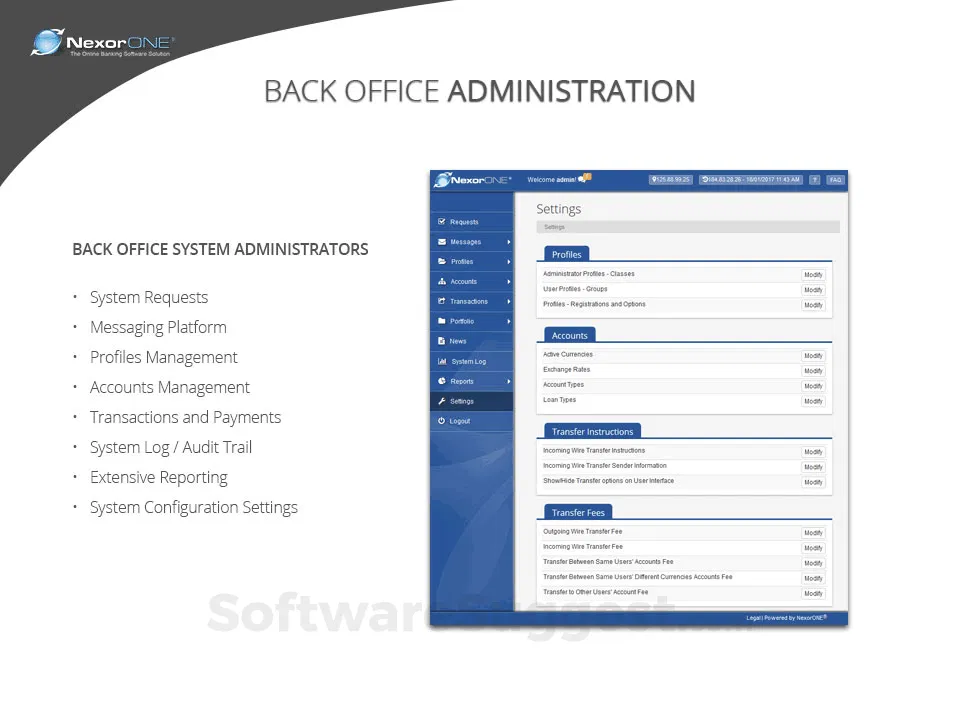
- User and administrative interfaces
- API integrations
- Additional modules and customizations
The objective is not modularity for its own sake.
The real value is the ability to start with current requirements and expand as those requirements evolve.
Integrations are part of the modernization decision
Modern financial institutions rarely operate within a single software environment.
Banking technology may need to connect with payment providers, reporting systems, identity services or other external technology.
As a result, integration requirements should be considered early in any modernization project.
Institutions should establish:
- Which external systems need to connect with the banking platform
- Which integrations already exist
- Which require additional configuration or development
- How data needs to move between systems
- Which integrations are required at launch
- Which can be introduced later
This can help prevent a modernization project from becoming unnecessarily large at the outset.
It also reinforces an important principle:
Not every future requirement needs to be implemented on day one.
Managing modernization risk
Core banking modernization affects critical operational systems, so risk management needs to form part of the implementation strategy.
Three areas deserve particular attention.
Data
Account information, transaction histories and other financial data need to be evaluated carefully when migration forms part of the project.
Migration scope, validation and testing requirements should be established according to the institution’s existing environment.
Integrations
External connections can significantly affect implementation complexity.
Understanding integration requirements early allows institutions to distinguish between standard platform implementation and additional project-specific work.
Operational readiness
Technology availability and institutional launch readiness are not the same thing.
Configuration, branding, testing, migration, integrations, staff preparation and other operational requirements may all affect the final implementation timeline.
This distinction is especially important when evaluating claims about deployment speed.
How NexorONE fits into a modernization strategy
Banking.Systems provides and supports NexorONE®, a configurable online and core banking platform designed for smaller and dynamic financial institutions and financial-service ventures.
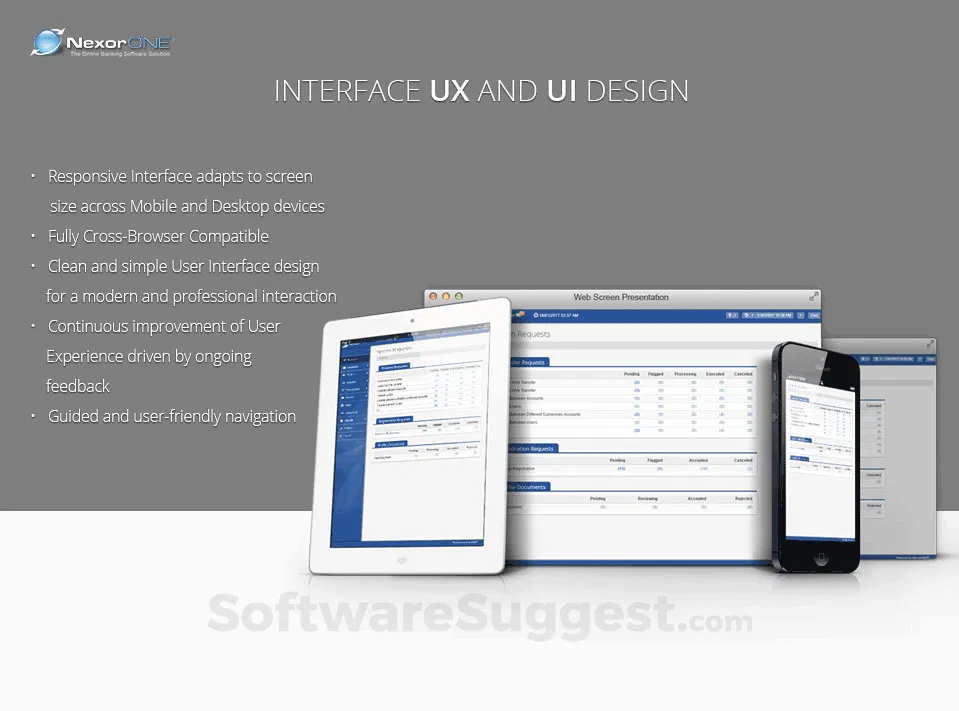
NexorONE can be configured according to an institution’s operational requirements, including functionality, modules, controls, reporting and interfaces.
This provides a practical growth path:
Start with what is required today and expand as the institution evolves.
Integrations and customizations can also be evaluated according to individual project requirements and the applicable scope and agreement.
For institutions considering phased modernization, this approach can provide flexibility in determining which capabilities should form part of the initial implementation and which can be introduced later.
A rapid starting point for implementation
Modernization projects can be complex, but making the underlying technology environment available does not necessarily need to be.
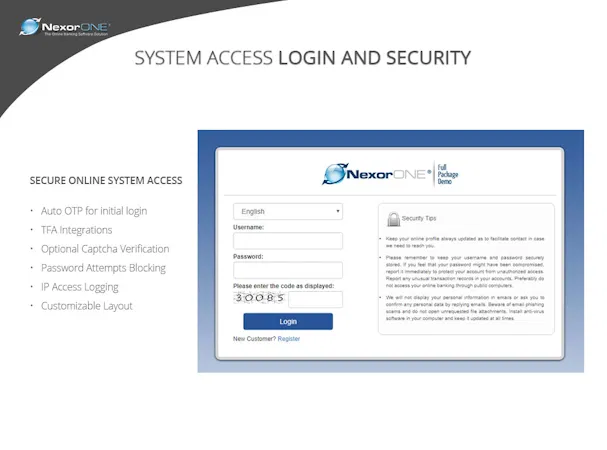
An operational NexorONE environment can be made available within 24 hours as part of the standard deployment process.
This provides a rapid starting point for implementation.
Importantly, this does not mean that a complete institutional migration or production launch necessarily occurs within 24 hours.
Institution-specific branding, configuration, integrations, data migration, testing, optional modules and full institutional launch readiness may require additional scope and implementation time.
Being precise about this distinction helps institutions establish more realistic project expectations from the beginning.
The economics of modernization matter too
A modernization decision should not be based on architecture alone.
Institutions also need to consider whether the technology investment is proportionate to the wider project.
The deployed NexorONE® Core Platform starts at $18,000, consisting of the $15,500 Core Software Package and $2,500 standard deployment.
Banking Grade Hosted Infrastructure starts at $300 per month.
Optional modules, integrations, customizations, migration and additional implementation requirements are scoped separately.
For smaller financial institutions and financial-service ventures, these starting economics can be particularly relevant because technology is only one component of the overall project budget.
Choosing the right modernization strategy
There is no single modernization strategy that is appropriate for every financial institution.
Before making a decision, institutions should consider:
- Which limitations of the current system actually need to be addressed
- Which functionality is required immediately
- Which functionality can be introduced later
- Existing and future integration requirements
- Migration scope and data requirements
- Operational risk
- Internal resources and expertise
- Initial and ongoing technology costs
- Infrastructure requirements
- The institution’s expected growth
The objective should not simply be to replace legacy technology.
It should be to establish a more appropriate technology foundation for the institution’s future requirements.
The bottom line
Legacy core banking modernization does not need to be an all-or-nothing decision.
For some institutions, complete replacement may be appropriate. Others may benefit from phased modernization, coexistence or gradually moving functionality away from an established core.
What matters is choosing an approach that balances operational requirements, implementation risk, flexibility and economics.
As financial services continue to evolve, institutions need technology that can evolve with them.
The strongest modernization strategy is therefore not necessarily the most dramatic one.
It is the one that provides a practical path from where the institution is today to where it needs to be tomorrow.
Explore NexorONE
Learn more about NexorONE’s configurable platform, starting economics and implementation approach.
Leave a Reply