
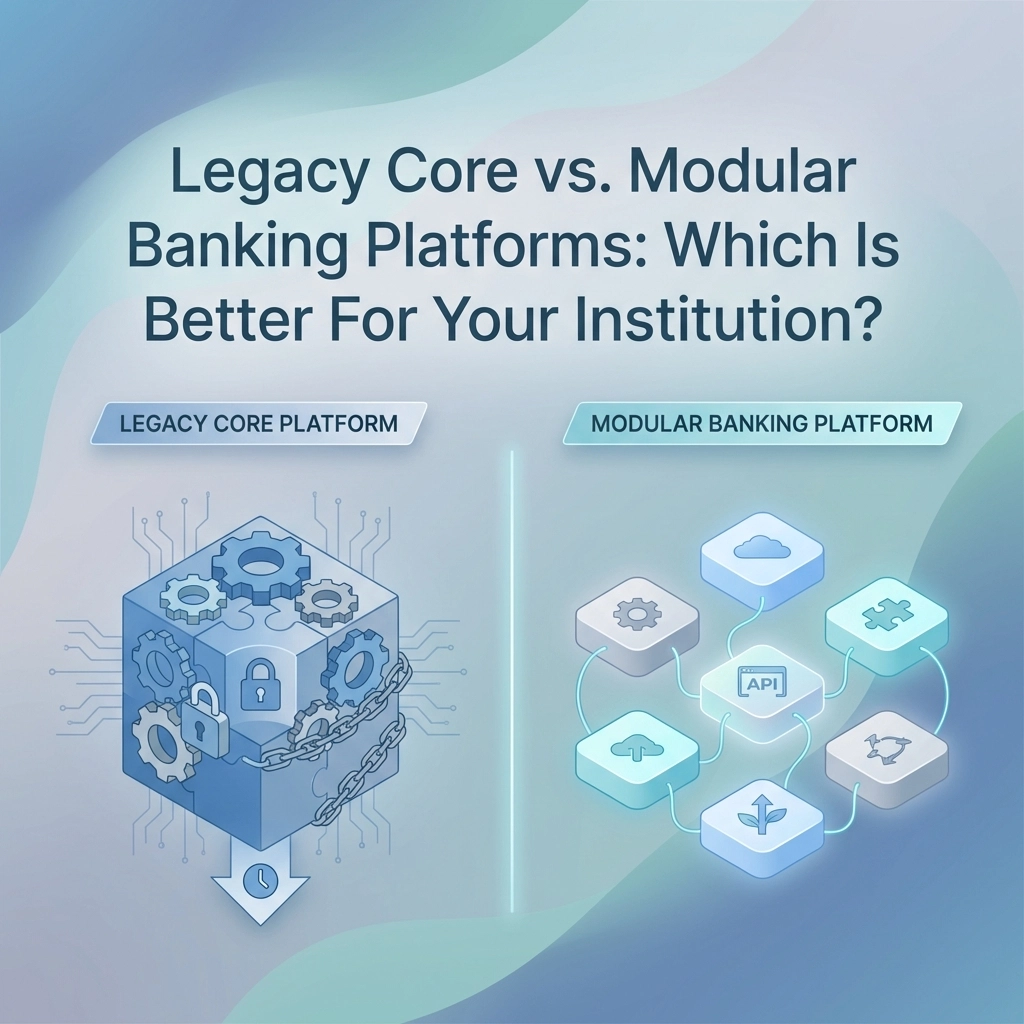
For many financial institutions, the question is no longer whether banking technology needs to evolve, but how that modernization should take place.
Legacy core banking systems have supported financial institutions reliably for decades. However, changing customer expectations, new integration requirements and increasing operational complexity can make older technology more difficult and costly to adapt.
At the same time, a modular core banking platform offers a different approach: functionality can be configured and expanded according to an institution’s requirements rather than treating the banking environment as one fixed system.
So, which approach makes more sense?
The answer depends on the institution, its existing infrastructure and what it needs its technology to accomplish.
Understanding the Core Difference
Traditional legacy core banking systems are often highly interconnected environments that have accumulated processes, integrations and customizations over many years.
That isn’t necessarily a weakness.
A mature legacy system may be stable, familiar to operational teams and deeply integrated into an institution’s existing processes.
The challenge appears when change becomes necessary.
Adding new services, integrating external technologies or adapting existing workflows can become increasingly complex when changes in one area affect multiple parts of the environment.
A modular approach aims to provide greater flexibility.
Instead of treating every banking capability as part of one inseparable system, institutions can work with functionality, modules and integrations according to their specific operational requirements.
The practical difference is therefore less about old versus new and more about how easily the technology can adapt when the institution’s requirements change.

When keeping a legacy core can make sense
Replacing an established core banking system should never be treated as an automatic decision.
There are legitimate reasons to continue operating an existing system.
Stability and institutional knowledge
An established system may have years of operational history behind it. Employees understand its processes, controls and limitations, and replacing that knowledge carries its own cost.
Existing integrations
Financial institutions may have substantial investments in integrations, reporting processes and operational workflows built around their current core.
Replacing those connections can significantly increase the scope of a modernization project.
Migration risk
Core migration affects critical financial data and operations.
Moving accounts, transaction histories, configurations and integrations requires careful planning, testing and validation. For some institutions, the operational risk of a full replacement may outweigh the immediate benefits.
Limited modernization requirements
If an institution’s current system continues to meet its operational requirements and relatively little change is expected, maintaining it may remain a reasonable strategy.
The important question is whether that situation is likely to continue.
When a modular core banking platform becomes attractive
The case for modernization becomes stronger when existing technology begins restricting what an institution can do.
The institution needs greater flexibility
Requirements change.
New products, workflows, reporting requirements and customer services may need to be introduced over time.
A configurable and modular platform can provide greater room to adapt the banking environment as those requirements evolve.
Integration is becoming increasingly important
Modern financial institutions rarely operate within a single technology ecosystem.
Payment services, identity solutions, reporting systems and other third-party technologies may all need to exchange information with the banking platform.
As a result, API integrations and the ability to work with external systems have become increasingly important considerations when evaluating banking software.
Legacy maintenance is becoming disproportionate
An existing system may technically continue to operate while requiring increasing resources to maintain it.
Institutions should therefore consider not only the immediate cost of replacing technology, but also the ongoing cost of maintaining systems that are increasingly difficult to adapt.
Growth requires a different technology foundation
A platform suitable for an institution today may not necessarily support its future requirements.
A modular approach can allow an institution to begin with the functionality it needs and expand as operations develop, rather than attempting to anticipate every future requirement at the beginning of the project.

Modernization does not always mean “rip and replace”
One of the most important decisions is not simply whether to modernize, but how.
A complete core replacement is only one possible approach.
Depending on the institution’s existing environment, requirements and risk tolerance, several strategies can be considered.
Full replacement
The existing core is replaced with a new platform.
This can provide a cleaner long-term technology environment, but it also typically involves the broadest migration scope.
Data, integrations, workflows, operational processes and user requirements all need to be evaluated as part of the transition.
For some institutions, that is appropriate. For others, a phased approach may be more practical.
Component-based modernization
Rather than changing the entire environment at once, selected functionality can be modernized progressively.
This allows an institution to prioritize the areas where new technology can provide the greatest immediate value while managing implementation scope over time.
Parallel environments
In some circumstances, existing and newer technology can operate alongside each other during a transition.
This can allow an institution to introduce new capabilities while retaining established systems for functions that are not yet ready to migrate.
The feasibility of this approach depends on the institution’s architecture, integrations and project requirements.
The “hollowing out” approach
Another modernization strategy is often described as hollowing out the core.
Instead of immediately replacing the legacy system, selected business capabilities can gradually be moved away from it and into a more flexible service layer.
Over time, the legacy core may perform a narrower role while newer technology supports additional customer-facing or operational functionality around it.
This can provide institutions with a more gradual path toward modernization rather than requiring a single large migration event.
— Remy Swaab, CEO, Banking.Systems
“We’ve seen institutions have tremendous success with the hollowing-out approach. NexorONE lets them modernize at their own pace without betting the entire operation on a single migration event.”
How NexorONE fits into a modular strategy
NexorONE® is a configurable online and core banking platform designed for smaller and dynamic financial institutions and financial-service ventures.
Rather than requiring every institution to adopt the same configuration, NexorONE can be scoped according to operational requirements, including functionality, modules, controls, reporting and interfaces.
This provides institutions with a practical growth path: begin with current requirements and expand functionality as those requirements evolve.
Integrations and customizations can also be evaluated according to the needs and scope of the individual project.
For institutions considering a phased modernization strategy, this configurability can provide greater flexibility in determining how and when new banking capabilities are introduced.

What about implementation speed?
Modernization speed matters, but it is important to distinguish between platform availability and a complete institutional migration.
An operational NexorONE environment can be made available within 24 hours as part of the standard deployment process.
This creates a rapid starting point for implementation.
It does not mean that an entire financial institution can necessarily migrate and launch within 24 hours.
Institution-specific branding, configuration, integrations, data migration, testing, optional modules and full institutional launch readiness may require additional scope and implementation time.
That distinction is particularly important when comparing technology providers and planning realistic modernization projects.
Consider the economics as well as the technology
Architecture is only one part of the decision.
Financial institutions should also evaluate whether the cost of a new banking platform is proportionate to the project itself.
The deployed NexorONE® Core Platform starts at $18,000, consisting of the $15,500 Core Software Package and $2,500 standard deployment.
Banking Grade Hosted Infrastructure starts at $300 per month.
Optional modules, integrations, migration, customization and additional implementation requirements are scoped separately.
For smaller financial institutions and new financial-service ventures, transparent starting economics can be particularly important because technology represents only one part of the overall project budget.
Making the right choice
There is no universal answer to the legacy-versus-modular question.
Maintaining an existing core may make sense when:
- The system continues to meet operational requirements
- Modernization requirements are limited
- Existing integrations remain effective
- The institution has the resources and expertise required to maintain the environment
- Migration risk currently outweighs the expected benefits
A modular core banking platform may deserve consideration when:
- Existing technology is restricting operational change
- New integrations are increasingly important
- The institution requires greater configurability
- Legacy maintenance is becoming disproportionately expensive or complex
- The institution wants technology that can expand alongside its operations
- A phased modernization strategy is preferable to a single large replacement project
The decision should ultimately be based on operational requirements, risk, implementation scope and economics — not simply on whether a technology is considered “legacy” or “modern.”
The bottom line
Legacy core banking systems are not inherently obsolete, and modular banking platforms are not automatically the right answer for every institution.
The real issue is fit.
Financial institutions need technology that can support their current operation while providing a practical path for future change.
For organizations finding that existing technology has become a constraint, a configurable and modular approach can provide a more manageable route toward modernization — without necessarily treating transformation as an all-or-nothing event.
Leave a Reply