
Banking technology has changed significantly from the days when every function of a financial institution depended on one large, tightly connected core system.
For smaller and growing financial institutions in particular, flexibility matters. New services need to be introduced, integrations added, operational requirements adjusted, and technology expanded without unnecessarily disrupting the entire banking environment.
This is one reason the concept of a microservices core banking platform has become increasingly relevant.
Instead of treating banking technology as one large application in which every component depends on the others, a microservices-based approach separates functionality into smaller, more focused services.
Here are five reasons why that matters.
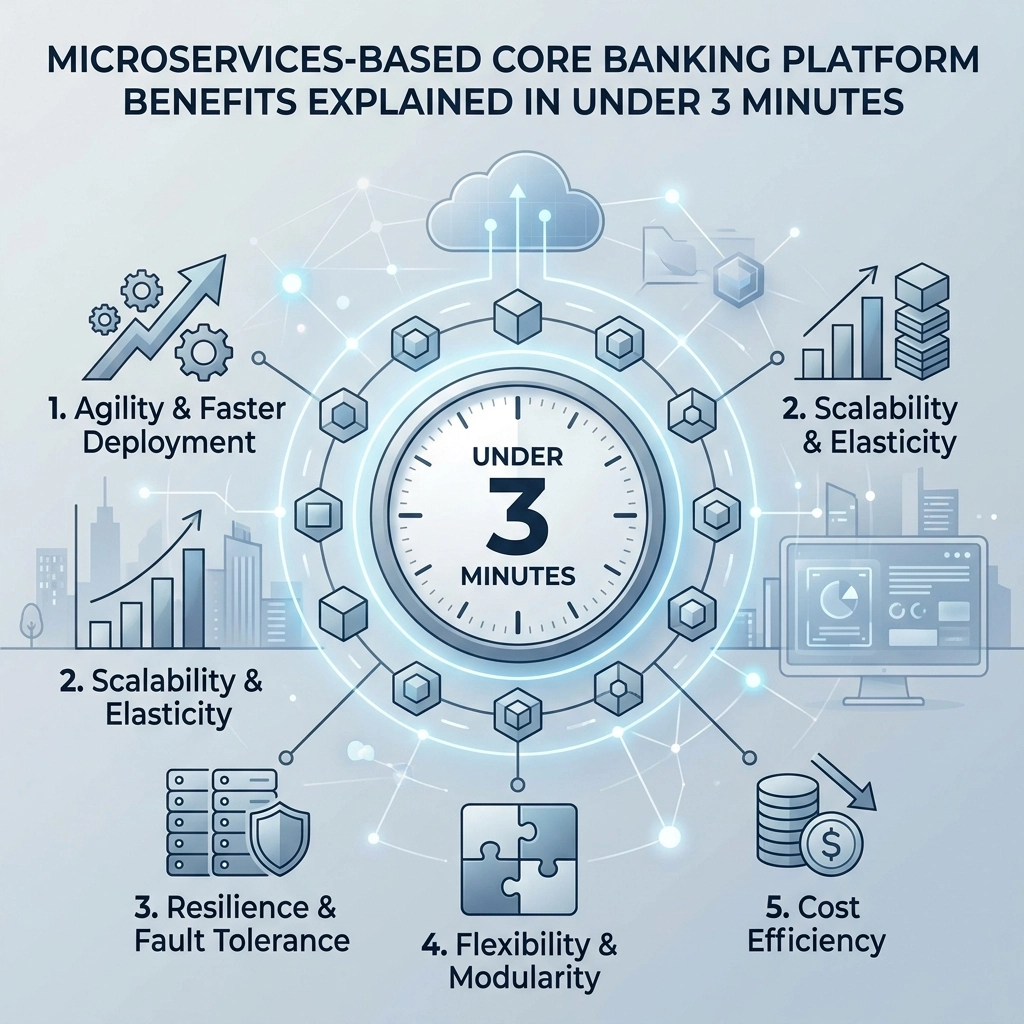
1. Greater flexibility as requirements change
Traditional monolithic core banking systems can make change difficult because many functions are closely interconnected. Updating one area may affect other parts of the system and require extensive testing.
A microservices-based approach separates functions into smaller components that can be developed, maintained or expanded more independently.
For financial institutions, the practical benefit is flexibility.
Rather than replacing or restructuring an entire banking environment every time requirements change, individual capabilities can potentially be adapted or expanded according to operational needs.
This is particularly relevant for smaller and dynamic financial institutions that need technology capable of evolving alongside the business.
2. A more practical path to scalability
Growth does not always happen evenly.
An institution may experience significantly higher demand for payments, transactions or customer-facing services while other areas of the operation remain relatively stable.
With a traditional monolithic architecture, scaling can mean increasing resources for the entire application.
A microservices architecture can provide a more targeted approach, allowing individual services to be scaled according to demand where the underlying implementation supports it.
For growing financial institutions, this can provide a more efficient foundation for managing changing transaction volumes and service requirements.

3. Faster development and deployment
Speed is increasingly important in financial services.
Institutions need to respond to new customer expectations, operational requirements, integrations and market opportunities without waiting for lengthy technology cycles.
Separating functionality into smaller services can make it possible for development teams to work on individual components without rebuilding or redeploying an entire core environment.
This can support:
- More focused development cycles
- Faster testing of individual components
- More targeted updates
- Reduced disruption during deployment
- Greater flexibility when introducing new functionality
The result is a technology environment that can be easier to evolve over time.
4. Easier integration with the wider financial ecosystem
Modern financial institutions rarely operate with a single technology provider.
Payment processors, identity services, compliance tools, reporting systems, mobile applications and other third-party services may all form part of the wider technology environment.
This makes API integrations an increasingly important consideration when evaluating a core banking platform.
A modular or service-oriented approach can make it easier to connect individual banking capabilities with external systems, provided the appropriate APIs and integrations are available.
For institutions evaluating new banking software, the question is therefore not simply:
“What does the platform do today?”
It is also:
“How easily can this platform work with the systems the institution may need tomorrow?”

5. A more manageable approach to modernization
Replacing a legacy core banking system can be a major undertaking.
In some cases, a complete replacement is appropriate. In others, institutions may benefit from a more gradual approach in which modern functionality is introduced around or alongside existing infrastructure.
A modular architecture can support this type of modernization strategy by allowing institutions to evaluate individual capabilities and integrations rather than treating modernization as a single all-or-nothing event.
This can provide a more practical path for institutions that want to modernize while managing operational risk, implementation scope and budget.
For a deeper look at this approach, read Legacy Core vs. Modular Banking Platforms: Which Is Better for Your Institution?
What does this mean when choosing a core banking platform?
Architecture matters, but it should not be evaluated in isolation.
A financial institution should also consider:
- The functionality required at launch
- Configuration options
- Integration requirements
- Implementation scope
- Hosting and infrastructure
- Security and operational controls
- Migration requirements
- Ongoing support
- Initial and ongoing costs
- The ability to expand as requirements evolve
The best technology architecture is ultimately the one that supports the institution’s actual operational and commercial requirements.
For smaller financial institutions, this is particularly important. A technically sophisticated platform provides little value if its cost, complexity or implementation requirements are disproportionate to the project.

Where NexorONE fits
NexorONE® is a configurable online and core banking platform designed for smaller and dynamic financial institutions and financial-service ventures.
The platform provides a practical path for institutions that want to begin with their current requirements and expand functionality as those requirements evolve.
NexorONE supports configurable functionality, modules, controls, reporting and interfaces according to project scope, while integrations and customizations can be evaluated based on individual client requirements.
The deployed NexorONE® Core Platform starts at $18,000, including the Core Software Package and standard deployment.
“The goal is to allow our clients to focus on their customers, not their infrastructure,” says Remy Swaab, CEO of Banking.Systems. “Microservices allow us to deliver a platform that evolves as fast as the market does. With NexorONE, we provide the blocks; the institution decides how to build the castle.”
Banking Grade Hosted Infrastructure starts at $300 per month.
An operational NexorONE environment can be made available within 24 hours, providing a rapid starting point for implementation. Institution-specific branding, configuration, integrations, migration, testing, optional modules and full institutional launch readiness may require additional scope and time.
NexorONE is available through Banking.Systems, which supports product evaluation, implementation coordination, customizations, integrations, infrastructure discussions and ongoing technical requirements according to the applicable project scope and agreement.

The takeaway
Microservices and modular architecture are not valuable simply because they are newer approaches to software development.
Their real value lies in what they can make possible: greater flexibility, more targeted scalability, easier integration and a more manageable path to technological change.
For smaller and growing financial institutions, those characteristics can be particularly important when selecting technology that needs to support both today’s operation and tomorrow’s requirements.